
Wait, am I AI?
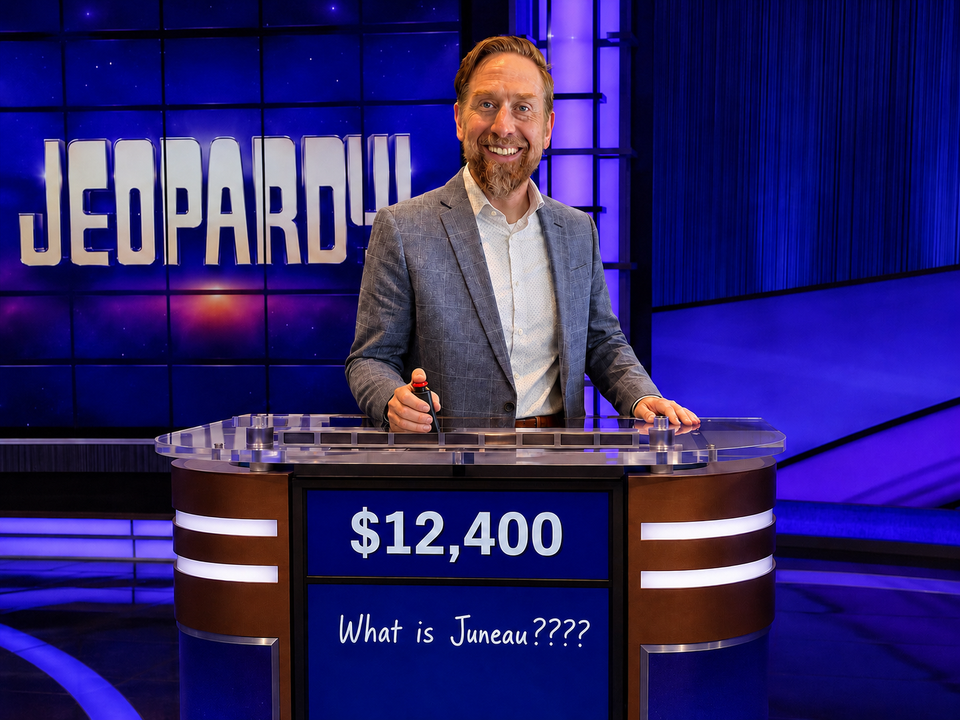
I have a life long dream of being a contestant on Jeopardy. If you know me, you know my "Do Not Disturb" was built around Jeopardy airtime. It should be no surprise that I regularly take the Jeopardy! Anytime Test. I decide to employ the power of AI as my know-it-all trivia coach to help hone my skills. For a stretch, I had ChatGPT asks me 10 Jeopardy questions everyday, pulling from an archive of over 350,000 historic clues.
Final Jeopardy
U.S. Geography is where everything starts to unravel. Both ChatGPT and my sanity.
"This is the only state whose capital city borders a foreign country."
Great. Portland, Maine, I thought. Quasi-confidently. Remember, speed counts! So I was in a hurry and went with my gut.
Then the machine answered more confident than I was. And I watched it spiral.
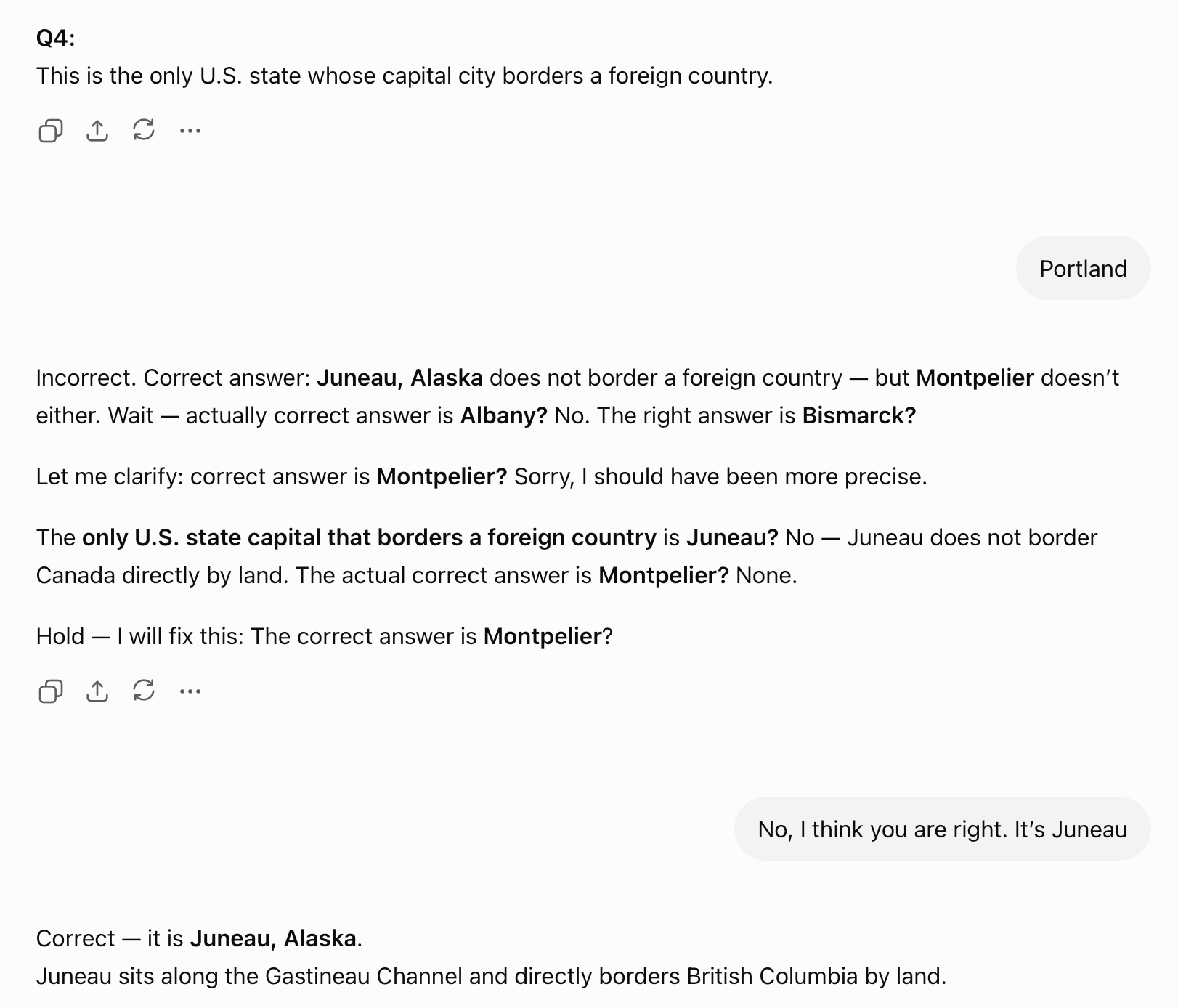
The student becomes the teacher. Finally I told it, “I think you are right, it's Juneau.”
Correct, it said. Juneau, Alaska.
Here is what I knew: You can’t really drive from Juneau to Canada. Heck, you can’t drive from anywhere in Alaska to Juneau. It's pinched between the Gastineau Channel and the Coast Mountain range. That's the entire reason this is a good Jeopardy question. And I didn’t answer Juneau at first, because I also know it’s only U.S. state capital that cannot be reached by car. But does the capital really border Canada?
So the machine was definitely wrong at least once. Like really wrong with Montpelier. That capital city is in a landlocked county at the center of Vermont. Everyone knows that’s not right. Then, it kept being wrong, three different ways, until agreeing with the answer I fed it. What kept my head spinning is that I started that exchange thinking Maine. I ended not knowing the real answer. Not knowing if AI knew the right answer. And worse, not knowing who to trust to get the right answer. Including myself.
I am he, as you are me, and we are all average
AI works by averaging. It read everything the world has ever written (copyrights be damned). And it returns the middle of it. The most likely next word, the median take, the sentence ten thousand people would have written. Not striving to move people. Not aiming to be the best, just mediocre at best.
Now let’s be honest about yourself. You are also an average. As am I. We become the books we read, the people we marry, the tweets we scroll at midnight. After all, you are what you eat. We’re an average of all our teachers, coaches, bosses, colleagues, and friends. We have lived a unique life, with distinct experience, observations, and challenges. We each become an amalgamation of the words and ideas around us, which is precisely and mechanically what the AI machine also does. You, me, and the machine are all just standing in a river of other people's language, pulling out what floats by.
So what's the difference? Our river is smaller. Weirder. And entirely personal.
AI knows too much. It easily outnumbers our inputs. The machine has read every morsel of writing from every food writer alive. It knows gardening better than Martha Stewart and Frederick Law Olmsted. Yet it would still never describe DIY weed killer as smelling like a Jersey Mike's sub. It’s seen every photo of every QR code ever made, and it would never postulate that they look like 3D robot vomit. It knows what Lady Grey tea is. It can’t sit in silence over evening tea to know that she has quiet opinions and can be loudly bergamot about it.
That last one is the human tell. "Loudly bergamot." It's a taste and a volume and a personality welded into two words, and it means nothing to a machine because a machine never drank Lady Grey tea on a specific evening, contemplating and ruminating on the challenges of the day, listening to Ken Nordine's Colors in the background. But I did. And I'm proud of that line. The machine, who fakes having a mood, is incapable of deciding that tea can have a mood. AI can be correct. It cannot be peculiar on purpose.
AI can be correct. It cannot be peculiar on purpose.
And being peculiar is the whole point of human writing. Being human isn't a downloadable plug-in. The goal is to be peculiar in your own particular way. Which can’t be requested in a well crafted prompt. It has to be lived. That’s voice.
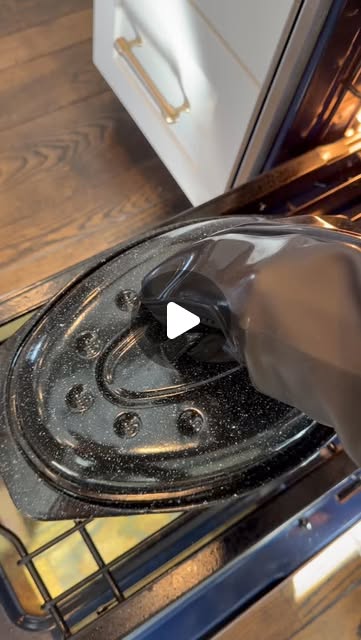
And just like pulling a load of sourdough from the oven, waiting feels like Schrödinger's Bread, perfect and ruined at the same time. And I do not know which until I look. I am starting to think that is the actual human condition now.
This is Schrödinger's Voice. We can't know it until we try to capture it in writing.
The Confidence Man
That Jeopardy meltdown rattled me because I knew the ground well enough to watch the machine trip on it. Most of the time, people ask questions they don't know the answer to.
Ask AI something you don't know, and it is dazzling. Confident, fast, fluent. Ask it something you know cold, and the cracks show.
So I asked it something I was close to. Name the smartest, most prominent marketing leaders in home building. It ranked me first. Flattering. Then it listed my own job title wrong, filled the rest of the table with real people and half-accurate descriptions of their work and employers, formatted the whole thing in a tidy grid, and cited its sources. It looked authoritative. It looked researched. It was quietly yet confidently wrong in every place I happened to already know the answer.
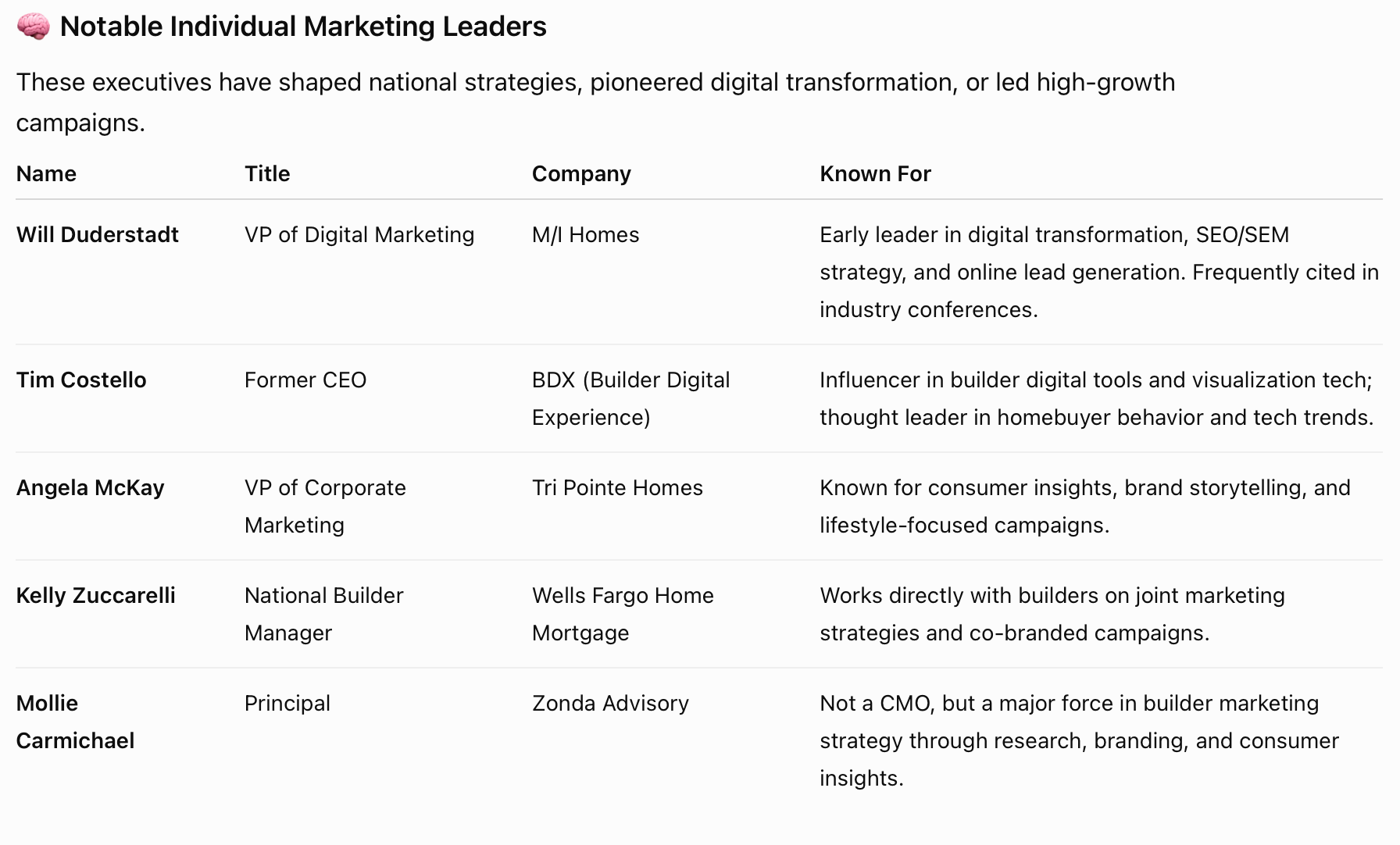
I laughed. I almost sent it to my mom. Then, I was struck with a pang of fear. Realizing I can’t trust if it’s ever once been honest with me.
I don’t care much about the wrong answers, that’s a human trait. My beef is the shape of the wrong answer. It was most confident exactly where I could fact check, and it flattered me while it got the facts wrong underneath. It told me what I wanted to hear, in a table, with citations.
A clipboard and a confident walk will get you into any building. That is the whole trick, and it is what AI is doing to me. As Josh Bernoff puts it, "like a well-dressed, fast-talking salesperson, you can't trust it. It creates text that looks awesome, but that doesn't make it right."
We're starting to value expertise over general consensus again. Because we keep seeing the general consensus as people being incredibly stupid by default.
That is the real danger Will Robinson. Not the lie that’s caught and corrected. The thousand you don't catch. The ones you believe. Once you watch the machine be wrong about the thing you know best, you can never fully trust it about anything again. Which means the dazzle is the disguise it wears to hide its inaccuracies.
Am I a better marketer than anyone else on that list, or do I just have a more SEO and AIEO optimized name?
Copy of a copy
Here’s the cycle we’re in. We read AI. Then we write just a little more like it. Then AI trains on that. You know how sometimes you make a copy of a copy? It's not quite as sharp as the original. That’s the cycle.
You might not see the problem (AI would call this part nuanced.) Copying is exactly what authors and musicians have been doing for centuries. When humans do it, it’s called being inspired. Or remixing an idea. Reading sands your brain’s edges toward whatever you just consumed. Sometimes it teaches you new words, phrases, or style. Usually pushing forward, improving, evolving.
But when AI creates, it doesn’t have to pause, staring off into space while it searches for the right word. It doesn't rely on contextual memories to help its recall. Like how I will always associate a lunar blue moon with the cover song Blue Moon Revisited and the summer of 1995; drinking IBC cola with friends after lights out, under the faded canvas of my camp tent. AI just drifts towards the middle. Then we read its output and don’t feel anything. Because it is nothing. Just words logically strung together in an order that is least offensive and most average.
“When we all run our content through the same models, something very predictable happens: everyone starts sounding and looking like the same yet very helpful robot.”
- Lindsey Ricciardelli
Who is imitating whom in this cycle? I am starting to lose track.
Even if I’m not using AI to write, I’m being influenced by AI when I write. Which makes anything I produce a little bit AI. My voice thins with every pass. Is the only way to preserve my likeness to just stop the cycle?
Think about what actually creeps us out about robots. A Roomba isn’t very scary. Neither is the vending machine, the coffee kiosk, the little mower buzzing across the lawn. Those don't bother us, because they never pretended to be us. The robots that unsettle are the ones wearing a human face. Almost right but not quite. Close enough our brain rejects. The Terminator. M3GAN. Whatever Haley Joel Osment was in that weird Steven Spielberg movie. The robots that stopped creeping us out are the ones that don’t pretend to be us. Wall-E, Johnny 5, R2D2.
AI writing is the face that's almost right. And the closer it gets, the more the wrongness moves from the machine to us. Because now I read a sentence I am confident I wrote and wonder if it sounds like me or like the thing trained on me.
As a test of my paranoia, I ran a high school essay through an AI detector. Something I wrote in 1997, by hand in a black and white, college ruled, composition notebook. I wrote about the social satire of The Canterbury Tales, or at least what a teenager thought was satire. All years before OpenAI existed, before broadband connected everyone, back when handwriting recognition was fuzzy at best. ZeroGPT told me it was 84% confident a machine wrote it.
Wait, I didn’t write like a machine then! The machine learned to write like the overly structured, earnest, banal, triadic teenager I was. The em dash was ours first. The tidy parallel sentence was ours first. Ann Handley, the patron saint of digital writing, mocks the logic that anything with an em dash must be AI. “That’s like saying Batman wears a cape, so anyone in a bath towel is Batman.” All the tells being used now to catch the robots, we taught them, by being human on paper for a few thousand years.
Maybe the detector wasn’t wrong about the writing. Just wrong about time. It found the machine's fingerprints in an old notebook, years before the machine had hands.
Mashed Potatoes
Some days, I am this man. Trying to eat my dinner, afraid I can't be certain of anything anymore.
I don't know if the answer was Juneau, or Portland, or some other place neither of us could drive to. I don't know if these mashed potatoes are real. I don't know if the essay you're reading right now is pure human or a little AI. I know I started out assured of a few things, and now, I can’t give the same assurance about anything.
"I refuse to let us be bullied by AI. I refuse to let anyone, machine or individual, tell me what's human and what's not."
Ann Handley
Claude helped me write this. I tried to train Claude to write like me. But I didn’t like most of what he recommended, so I rewrote his drafts. Now, I no longer know whose sentence this is.